

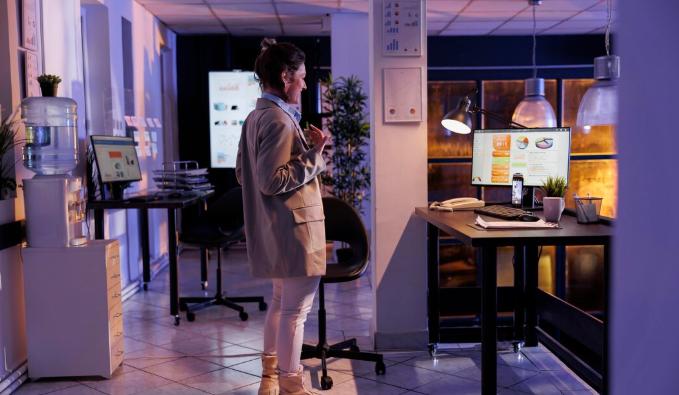
The future of filmmaking is beginning to appear oddly quiet on a quiet street near the former studio lots in Los Angeles. There were no trailers parked outside. Excessive smoking is prohibited next to catering trucks. Cables are being hauled across the asphalt without grips. It was just a small office with humming servers, glowing monitors, and a few engineers watching footage that had not existed an hour before.
This appears to be the appearance of a Hollywood studio that relies heavily on artificial intelligence.
| Category | Details |
|---|---|
| Concept | Film production studios using AI across writing, visual effects, editing, and digital actors |
| Technologies Used | Generative AI video models, large language models, AI voice synthesis, visual generation |
| Production Process | AI assists in scripting, storyboarding, generating scenes, editing, and post-production |
| Industry Context | Hollywood exploring AI tools for faster and cheaper film production |
| Emerging Companies | AI-driven media startups and experimental studios exploring automated filmmaking |
| Major Concern | Job loss among writers, artists, editors, and background actors |
| Creative Debate | Whether AI can replicate human storytelling and emotional nuance |
| Recent Developments | AI-generated scenes and synthetic actors appearing in modern film projects |
| Industry Reaction | Actors’ unions demanding protection of voice and likeness rights |
| Reference Source | https://www.bbc.com/news/articles |
At first, the concept seems a little ridiculous. Hollywood has always been a hive of activity, with actors practicing lines in between takes, directors yelling directions, and cinematographers squinting through lenses. However, there has been a slight change in the last two years. Artificial intelligence (AI) tools that can write scripts, create characters, and even create entire scenes are starting to show up in the filmmaking process.
The tools were little aids at first. software that could modify lighting or clean up audio after production. However, a few experimental studios are now attempting something more drastic: allowing algorithms to manage almost the whole filmmaking process.
One such procedure starts with a prompt entered into a laptop. A producer—or occasionally just an engineer—enters with a brief concept, such as a science-fiction epic on Mars, a romantic comedy in Tokyo, or a thriller set in a destroyed city. The system creates rough storyboards, character descriptions, and a script outline in a matter of minutes. The speed is nearly frightening.
A single plot twist can be the subject of months of discussion in traditional screenwriting rooms. Here, dozens of variations—each slightly different—appear instantly, resembling alternate universes playing out on a screen. Observing the process gives me the odd impression that storytelling is evolving into something more akin to software. However, technological revolutions have already occurred in Hollywood.
Actors in silent films used to be afraid of sound movies. Similar fear was evoked by color film. Traditional cinematography was under threat from digital cameras. At one point, streaming services appeared to pose an existential threat to studios. The industry wavered but did not completely collapse each time.
But AI feels different. It touches the creative core of filmmaking, not because it modifies distribution or cameras.
A brief AI-generated video of Brad Pitt and Tom Cruise fighting on a burned-out highway went viral earlier this year. The video appeared remarkably authentic. Actors’ unions were outraged, claiming that the technology could exploit actors’ likenesses without their permission. A deeper tension simmering in Hollywood was exposed by the backlash.
Actors are concerned about having their faces imitated. Algorithms trained on decades’ worth of scripts are a concern for writers. Animators are concerned that in the future, software might create scenes more quickly than a human team could. The technology seems to have arrived sooner than anyone anticipated.
The atmosphere inside the experimental AI studios is more realistic.
Many of the engineers who work there maintain that technology is only speeding up filmmakers rather than replacing them. They contend that while humans are still in charge of taste and narrative, AI can handle laborious tasks like creating backgrounds, testing scene variations, and editing raw footage.
That argument makes a certain amount of sense. Emotional coherence in lengthy narratives is a challenge for even the most sophisticated AI systems. Even though individual scenes are impressive, the overall plot seems strangely hollow. However, it is difficult to ignore the economics.
The price of a traditional film can reach hundreds of millions of dollars. For a small portion of that, AI tools promise to create high-quality video. Unsurprisingly, investors are taking notice. Smaller “micro-studios,” driven by algorithms and small teams, are perceived as having the potential to compete with large-scale Hollywood productions.
It’s difficult to ignore how different one of these experimental offices feels from a vintage movie set. There are no costume racks. Cranes don’t have cameras. Just rows of computers creating characters, landscapes, and lighting conditions that would typically take entire departments. Work quietly. Almost unsettling.
However, when the generated scenes start to play on a big screen, something intriguing happens. Viewers still react emotionally, laughing at jokes and leaning forward during tense moments, even though they are aware that they were produced by software. It appears that storytelling is effective even when the storyteller is somewhat synthetic.
However, it’s still unclear if audiences will enjoy movies produced primarily by algorithms. After all, human personalities—directors like Spielberg, actors like Meryl Streep, and writers whose voices shape entire genres—have always been the foundation of Hollywood’s myth factory. Audiences are familiar with the signatures, styles, and reputations of films.
In contrast, an AI studio creates films that lack a distinct author. Audiences might not give a damn. People might just watch if the story is good.
However, there’s also a persistent sense that cinema is about more than just moving pictures on a screen, which is hard to put into words but hard to ignore. It’s about the messy human process that goes into those pictures. the set of arguments. The improvisations. The errors that unintentionally turn into famous moments. Curiosity and reluctance coexist as these AI studios grow in popularity.
Technology is developing at a rapid pace. quicker than most people anticipated. And a new Hollywood is already starting to take shape somewhere in Los Angeles, in quiet rooms full of computers rather than cameras.
