

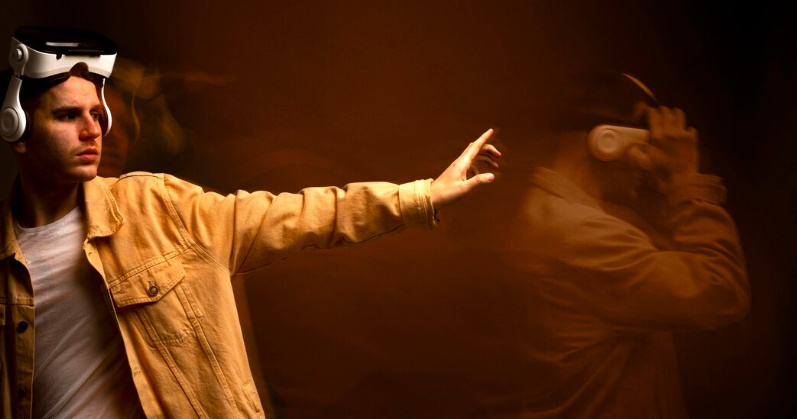
Something odd is taking place inside a huge soundstage in Hollywood. At first glance, the room appears unremarkable with its black curtains, cables running across the floor, and the subtle scent of coffee emanating from a folding table close to the wall.
However, a city skyline appears out of nowhere on a massive monitor. Towers are formed. Automobiles move. Above rooftops, smoke curls. No tiny models. No army of green screens. A world is silently put together by an algorithm and a single line of code. It’s possible that this is where movie magic is being rewritten.
| Category | Details |
|---|---|
| Industry | Film and Visual Effects |
| Location | Hollywood |
| Major Film Studios | Disney, Paramount Pictures, Universal Pictures |
| Example Technology | Generative AI visual effects and deep-learning video tools |
| Film Director Experimenting with AI | Timur Bekmambetov |
| Actors Used in AI-assisted effects | Tom Hanks, Harrison Ford |
| Industry Labor Group | SAG‑AFTRA |
| Key Concern | AI replacing VFX jobs and digital actor replicas |
| Estimated Impact | Billions in potential cost savings for film production |
| Reference Website | BBC |
Hollywood’s visual effects divisions functioned as massive digital workshops for decades. For months, hundreds of artists animated distant galaxies, creatures, and explosions frame by frame. The work was done with great care. It can be excruciatingly slow at times. Thousands of visual-effects shots, each requiring layers of compositing, lighting adjustments, and rendering time that could take weeks, may be needed for movies like those made by Disney or Universal Pictures.
AI video tools of the latest generation can create environments, mimic lighting, and alter footage after it has been shot. With a few cues, a street scene during the day can turn into a storm at midnight. Without reshooting the scene, an actor can look younger, older, or somewhat different. There’s an odd mixture of anxiety and excitement in the room as editors test these tools.
In less than ten minutes, the software created a sophisticated visual effect, according to one engineer’s quiet account of the event. Everything is altered by that kind of speed.
By conventional studio standards, director Timur Bekmambetov’s experiments with these technologies seem almost reckless. He once started working on a movie that was mostly composed of AI-generated images, incorporating the flaws and distortions of the technology into the story. According to reports, the experiment was much less expensive than what might be needed for a traditional production.
A significant amount of the $150 million or more that blockbuster movies typically cost goes toward visual effects. AI technologies offer the alluring prospect of smaller teams creating greater spectacle. Executives can’t help but notice as they gaze at balance sheets. However, the industry’s overall sentiment is still nuanced.
A few years ago, SAG-AFTRA members carried signs warning about artificial intelligence and marched outside studio gates. Actors were concerned about unapproved use of digital copies of their faces. Visual-effects artists were concerned that algorithms would take the place of the laborious craft they had spent years perfecting.
It was hard to ignore the tension when standing close to those protests. In Hollywood, technology frequently shows up in a friendly disguise. Then everything is subtly altered.
The panic, according to some filmmakers, is premature. They contend that AI is just another tool, much like computer graphics used to be. When digital computer-generated imagery (CGI) first emerged in the 1990s, traditional effects artists responded with similar skepticism. In the end, those resources contributed to the production of movies that shaped entire generations.
AI has already made subtle on-screen appearances. Software was used to improve a character’s accent during dialogue in a recent production. In another, actors portraying various stages of life had their age differences mitigated by digital techniques. The technology frequently functions covertly, blending in with scenes so smoothly that viewers are unaware of it. That could be the point.
The real change might not come from amazing new images, but rather from who gets to make them. Tools that were previously only available to large visual-effects houses are now available to independent filmmakers working from home workstations or small studios. Environments that formerly required hundreds of technicians could be created by a single creator.
It’s difficult not to wonder what will happen to the conventional studio system as this develops.
Hollywood has always relied on scale: enormous marketing campaigns, costly equipment, and large crews. Because AI tools lower the barrier to entry, they pose a threat to that structure. The filmmaking hierarchy starts to falter when a small team can create images that are on par with blockbuster quality.
Even the most sophisticated AI system still has trouble making narrative decisions, such as when to make a dramatic reveal, change the lighting to reflect an emotional moment, and determine when less spectacle might be more impactful. Those choices continue to be stubbornly human.
Walking through contemporary production studios, where programmers now sit next to cinematographers, makes it hard to avoid feeling as though a new stage of filmmaking has already begun. Landscapes are created by computers. Actors engage with virtual worlds that might not be created until after production. Algorithms that suggest visual possibilities work with editors.
It’s unclear if AI will eventually free filmmakers or unnerve the industry’s labor force. Hollywood has always struck a balance between anxiety and innovation. Stars from the silent era used to be afraid of sound movies. Film purists used to be in danger from digital cameras. Algorithms are now at the center of the debate.
Without a single explosion on set, another impossible scene is rendering itself into reality, frame by frame and line by line, somewhere on a monitor inside a dark editing suite.
