

The confidence is almost tangible when you stand on the corner of Broad and Wall on a Tuesday morning. Financial news tickers cycling through record numbers, suited traders moving purposefully, and the entire American financial ecosystem functioning with the unique confidence of those who have been repeatedly reassured that the numbers are fine. Record highs have been tested by the S&P 500. Portfolios have been updated. The more upscale dining establishments in lower Manhattan have conversations that are easygoing and unconcerned. And that’s what should make you hesitate more than anything else.
Because a different set of indicators has been subtly moving in the opposite direction somewhere behind those record numbers. The creation of jobs in the US has stalled. The rate of unemployment is gradually rising. Even as the economy slows down, tariffs have been driving up import costs, which has led to an inflation rate that is still higher than the Federal Reserve’s 2% target. The stock of regional banks has been declining. Shares of homebuilders are declining. The airlines are not operating. These are cyclically sensitive companies that typically reflect actual economic conditions before the headline indices do; they are neither fringe industries nor speculative positions. Even if the overall market hasn’t yet adjusted, those who have experienced prior cycles usually notice when they all turn at about the same time.
| Topic Overview: US Economic Warning Signs & Recession Risk 2025–2026 | Details |
|---|---|
| Stock Market Status | S&P 500 testing record levels repeatedly through late 2025 despite slowing growth indicators |
| Fed Chair Assessment | Jerome Powell described stocks as “fairly highly valued” — widely seen as deliberate understatement |
| US Unemployment Trend | Rising — job creation has stalled despite immigration curbs; manufacturing and small business slowing |
| Top Earner Spending Share | Top 10% of earners account for nearly half of all US consumer spending — highest level since late 1980s |
| Stock Wealth Concentration | 30% of American wealth held in equities — concentrated heavily among top earners |
| Defensive Sector Rotation | Utilities, healthcare, consumer staples leading S&P 500 — first time since June 2022 |
| Key Analyst Warning | Mark Zandi, Wall Street analyst: economy avoids recession only if wealthy continue spending |
| AI Market Narrative | Record Wall Street run driven by AI growth bets — parallels drawn to late-1990s dot-com boom |
| Last Major Market Crash | 2008 financial crisis — 17 years ago; most current traders under 35 have no lived experience of it |
| Tariff Impact | Rising import costs pushing inflation above Fed’s 2% target; adding pressure to already-slowing economy |
| Trump-Powell Conflict | President publicly seeking Fed chair’s removal — market stability partly contingent on rate-cut expectations |
In late 2025, Jerome Powell, the chair of the Federal Reserve, described stock valuations as “fairly highly valued” despite being publicly targeted for removal by the president whose economy he is supposed to be managing. The restraint in that phrase merits a moment of admiration. US stocks are incredibly valuable by historical standards, trading at multiples that have only been surpassed in a few instances throughout market history, the majority of which resulted in corrections. Powell is aware of this. His language was calibrated, the tactful wording of someone who is unable to express clearly what he probably believes without causing markets to move in the direction he is attempting to avoid.
The rally is primarily being driven by a single wager: that artificial intelligence will significantly boost economic growth, supporting valuations that are not supported by current earnings. This wager might turn out to be right in the end. However, it will take years or even decades for AI to have that kind of macroeconomic impact, and markets are pricing it as though the benefits are already mostly realized. It’s a familiar position. Similar reasoning underpinned the technology boom of the late 1990s; the internet did, in fact, revolutionize the economy, but it did so at a rate that, looking back, made the majority of 1999 stock prices seem ridiculous. That time, nothing was different. Why it would be different now is not immediately apparent.
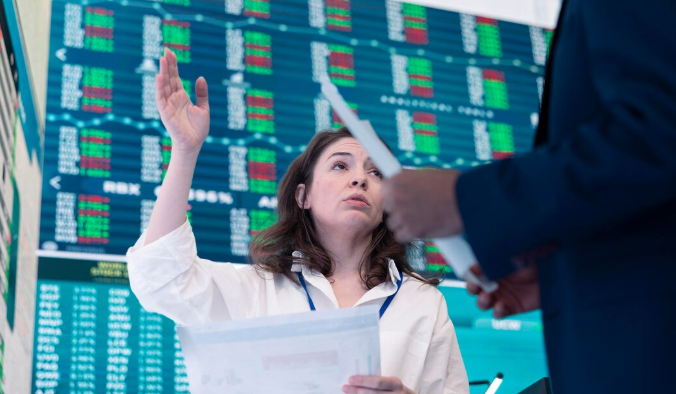
The distribution question—who is truly supporting the economy and how vulnerable they are to a market reversal—makes the current state of affairs especially precarious. Nearly half of all consumer spending is currently accounted for by the top 10% of American earners, the highest concentration since the late 1980s. The ownership of stocks, which make up about 30% of American wealth, is significantly skewed toward the higher income groups. According to Wall Street analyst Mark Zandi, the implication is that the wealthy currently control the US economy. Growth will continue as long as they continue to spend. Their spending follows if their wealth is negatively impacted—by a market correction, a change in sentiment, or nearly anything that results in a significant decline in stock prices—and the economy as a whole suffers. That’s not a solid base. It’s a web of interdependencies that functions flawlessly until it breaks.
Silently and without much fanfare, the investors who have been keeping an eye on things have already started making adjustments. In the fall of 2025, utilities, healthcare stocks, and consumer staples—the industries that consistently produce cash flows regardless of economic cycles—led the S&P 500 for the first time since June 2022. Whether or not the economy is growing, people still buy electricity. During recessions, groceries and drugs do not disappear from shopping lists. When defensive sectors begin to lead, it usually indicates that serious investors have begun hedging against scenarios that the headline index does not yet reflect. A crash is not assured by that rotation. However, those with long memories interpret this type of signal as significant.
Although it is difficult to measure, the complacency risk is likely the most hazardous. Apart from the extraordinary disruption caused by the pandemic, the last prolonged market collapse occurred approximately 17 years ago, during the financial crisis that followed the September 2008 bankruptcy of Lehman Brothers. Traders in their 20s and 30s lack firsthand knowledge of what a real market panic looks like. They have studied it, read about it, and heard about it from more experienced coworkers. However, reading about a market rout and actually experiencing one are completely different, as are the behavioral reactions they elicit. The more time has passed since a market’s last significant correction, the more normal the current situation feels, and the harder it is to take the warning signs seriously.
It’s still unclear if what’s developing beneath the surface will end quietly—through a slowing pace, a soft landing, or a cycle of rate cuts that re-inflates sentiment—or if the confluence of overpriced stocks, concentrated spending power, growing tariff costs, and a political impasse over monetary policy will ultimately result in something more ugly. In all honesty, no one knows, and anyone who asserts certainty in either direction is most likely trying to sell something. What appears to be fairly obvious is that the discrepancy between how the market appears and how important parts of the real economy feel has been growing long enough to warrant careful consideration. Rising unemployment and record stock prices typically don’t last forever. Usually, one of them adapts to fit the other.
