

Office buildings are currently experiencing a subtle unease that isn’t quite evident in any quarterly report. The software engineer who takes a bit too long to respond to the question “how’s work going?” is an example of how it manifests itself. The paralegal has begun attending night classes. The mid-level analyst who recently hinted to a coworker that she was considering returning to school to become a nurse, albeit in jest. Most people sense that something is changing before they can identify it.
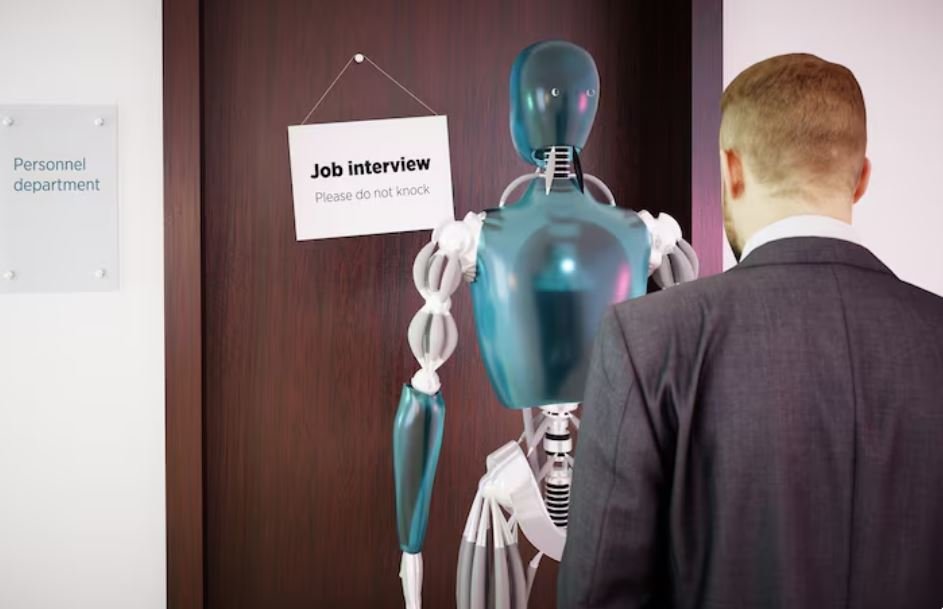
When you sit with the numbers, they are truly shocking. According to Goldman Sachs, AI has the potential to eliminate 300 million full-time jobs worldwide. Approximately 92 million jobs will be eliminated by 2030, according to the World Economic Forum’s Future of Jobs Report 2025. Nearly half of all entry-level white-collar jobs in technology, finance, law, and consulting could be replaced or eliminated completely, according to Dario Amodei, CEO of Anthropic, a company that creates this technology for a living. It’s possible that nobody truly understands how quickly this is approaching. However, the path appears to be fairly obvious.
| Subject | Impact of Artificial Intelligence on Global Labor Markets |
| Key Report | World Economic Forum — Future of Jobs Report 2025 |
| New Jobs Projected by 2030 | ~170 million globally (14% of current employment) |
| Jobs Displaced by 2030 | ~92 million (net gain: 78 million roles) |
| Goldman Sachs Estimate | Equivalent of 300 million full-time jobs at risk globally |
| High-Risk Task Overlap | ~35% of white-collar tasks (Harvard Business School) |
| Fastest-Growing Roles | AI/ML specialists, data analysts, cybersecurity experts, care workers |
| Most AI-Resilient Jobs | Nurses, therapists, early educators, skilled tradespeople |
| Key Prediction (Anthropic CEO) | Up to 50% of entry-level white-collar jobs in tech, finance, law may be eliminated |
| Reference Source | World Economic Forum — weforum.org ↗ |
The nature of what is being automated is what sets this current wave of automation anxiety apart from all others. Hands were involved in the last industrial revolution. Minds will be tested by this one. Instead of replacing factory workers, software that can write code, draft contracts, analyze medical scans, and summarize a hundred reports before you’ve finished your morning tea is replacing people who attended college, obtained professional credentials, and built careers around precisely that kind of thinking. That disruption is different, and it’s also landing in a different way.
It’s still too early to make firm decisions, according to Harvard Business School professor Christopher Stanton, who teaches a course titled “Managing the Future of Work”. Although he takes care to distinguish tasks from jobs, he observes that about 35% of tasks in white-collar labor data overlap with what AI is currently capable of. The optimistic view is that when a machine completes a portion of a task, the human left in charge can focus on the tasks that truly required them to be human. The pessimistic view is that fewer people are required to complete the task. In different industries, both are most likely true. The technology itself may not have as much of an impact on the version that rules the next ten years as how aggressively businesses choose to implement it.
And they are deploying it. According to Microsoft CEO Satya Nadella, AI now produces 20–30% of the code for some company projects. According to Y Combinator reports, early-stage startups are using AI tools to write most of their code. That would have sounded like science fiction four years ago. Sitting with how quickly that actually occurred is worthwhile.
It turns out that the jobs that are still in place have something in common that is more difficult to distill into a prompt than most people first thought. One is nursing. Imagine a busy hospital ward during shift change, complete with beeping monitors, a patient in room three whose symptoms changed overnight, and a family member dragging a nurse aside. No system operating on servers in Virginia can replicate the physical, emotional, split-second, and irreducibly human nature of the work being done there; it is not just clinical. According to McKinsey’s research, social and emotional skills are not only the most difficult to automate, but their demand in the labor market is also expanding at the fastest rate. It’s not a coincidence.
Counselors and therapists work in similar fields. Genuine therapeutic progress relies on the development of trust over the course of sessions, on observing how a person’s voice changes when they bring up a specific memory, and on the kind of presence that neither a screen nor an algorithm can provide. For early childhood educators, the same reasoning holds true. Information delivery is unnecessary in a classroom of five-year-olds. It requires physical presence, warmth, instinct, and the capacity to read a room that is changing every two minutes. There’s a reason why parents and authorities have never given automated caregiving much thought as an alternative.
However, it’s difficult to ignore the fact that the most cleanly surviving jobs are frequently among the least glamorous and, historically, among the lowest paid. Delivery drivers, construction workers, farmworkers, and software developers are among the jobs on the WEF’s list of the fastest-growing occupations by absolute numbers. White-collar jobs, which were once thought to be the safest, now appear to be less durable than the invisible architecture of care and physical labor that society always took for granted.
The true picture is genuinely unclear for workers in the middle, whose jobs require a combination of repetitive cognition, communication, and judgment. Even in jobs where AI adoption was high, a large study of 25,000 workers in Denmark found no discernible impact on hours or earnings. Research on freelance platforms reveals that while demand for AI-related tasks is rising, demand for writing and translation work is drastically declining. The shift may be slower in full-time employment than in freelance markets, but that doesn’t necessarily mean it won’t happen.
You most likely won’t be replaced by an AI system, according to Oren Etzioni, the founding CEO of the Allen Institute for Artificial Intelligence. However, someone who is more adept at using AI could replace you. Compared to the majority of writing on this topic, that framing is less concerning and more practical. The revolution isn’t necessarily coming in the form of a wave that instantly eliminates whole job categories. It’s coming in the form of a slow, unrelenting pressure that rewards those who give in to it and penalizes those who try to resist it.
According to Sam Altman, every significant technological advancement in history has led to predictions of widespread unemployment, but none of them have come to pass as anticipated. Regarding the historical pattern, he is most likely correct. His assurances have a somewhat nuanced quality because he is also one of the individuals most responsible for ensuring that this specific shift is distinct from all the others. However, his main argument remains true: society adapts, new roles emerge, and the nature of work changes, even if this adaptation is difficult and unevenly distributed.
When all of this is taken into consideration, it is evident that the professions that will survive the AI jobs revolution aren’t always the most prestigious or lucrative. They are the ones that are based on their unquestionable, indispensable presence. The nurse by the patient’s bed. The therapist is waiting for a break. The teacher becomes silent when she sees the child in the corner. The expert craftsman whose hands can comprehend concepts that no language model can. That has an almost poetic quality, and it’s something we should consider seriously before the next ten years are over.
