

The production lines at Taiwan Semiconductor Manufacturing Company’s expansive fabrication facility in Hsinchu run nonstop, twenty-four hours a day, seven days a week. Wearing full cleanroom suits, technicians keep an eye on machinery that produces chips that will be used in data centers, smartphones, and AI servers on every continent. The machinery operates at tolerances measured in atoms. The structure itself doesn’t appear to be at the heart of the decade’s most significant industrial narrative. It appears to be a quiet, spotless factory. The financial structure of the entire global technology economy is being altered by what passes through those production lines and the rate at which demand for it has increased. In 2026, the semiconductor industry’s yearly revenue will surpass $1 trillion. Four years ahead of nearly everyone’s predictions.
Global chip sales reached $791.7 billion in 2025, up 26% from the previous year, according to a February confirmation from the Semiconductor Industry Association, which also predicted that the $1 trillion mark would be surpassed in 2026. By 2030, that milestone was expected to be reached. Based on years of consistent cyclical growth and predictable demand trends, the forecast assumed that the industry’s historical compound annual growth rate of about 10 percent would continue at roughly the same rate. Then artificial intelligence emerged, or more precisely, the infrastructure needed to operate AI on a commercial scale emerged, and the timeline shrank to the point where most forecasters were caught off guard. Three years in a row of growth of more than twenty percent. That kind of thing hasn’t happened in the semiconductor industry since the early 1990s PC boom. The scale is significantly larger now.
| Industry Overview: Global Semiconductor Market 2024–2030 | Details |
|---|---|
| 2024 Market Size (Traditional Estimate) | $630–680 billion (standard sales-based measurement methodology) |
| 2024 Market Size (McKinsey Revised) | $775 billion — includes OEM in-house design, captive chip designers, fabless operators, and Chinese companies |
| 2025 Global Chip Sales | $791.7 billion — up 25.6% year-over-year (Semiconductor Industry Association) |
| 2026 Sales Forecast | Approximately $1 trillion — confirmed by SIA; Bloomberg cites Nvidia-led AI boom as primary driver |
| Timeline Acceleration | $1 trillion milestone arriving roughly four years earlier than predicted — original forecast was 2030 |
| 2030 Revised Forecast (McKinsey) | $1.5–1.8 trillion range; base case $1.6 trillion — significantly above previous $1–1.1 trillion consensus |
| 2025 Growth Rate | 23% year-over-year — part of three consecutive years of 20%+ growth, unseen since PC boom of 1993–1995 |
| 2026 Growth Rate Forecast | 26% projected — continuing acceleration driven by AI data center buildout |
| 47-Year CAGR (1979–2026) | 10.1% compound annual growth rate across full semiconductor industry history |
| Key Growth Segments | Leading-edge chips, high-bandwidth memory (HBM), GPU — showing winner-take-all dynamics |
| Struggling Segment | Microcontrollers (MCU), mature node chips, NAND flash — facing pricing pressure and Chinese competition |
| 2023 Market (Comparison Point) | ~$520 billion — down roughly 10% that year; recovery and acceleration followed |
The January 2026 analysis by McKinsey gives the headline numbers a crucial dimension that the majority of coverage has overlooked. For businesses that sell chips directly to consumers, standard semiconductor market sizing is based mostly on reported sales volumes. For OEMs that create chips internally, it performs less well. Apple is a prime example, as its unique silicon is integrated into iPhones, Macs, and iPads but is never sold externally. Additionally, it consistently undervalues Chinese semiconductor companies whose sales data is either purposefully opaque or incomplete, and it understates the contribution of fabless operators with particular packaging arrangements.
The 2024 market was valued at $775 billion after McKinsey modified its methodology to take all of these factors into consideration, as opposed to the $630 to $680 billion range that traditional analyses had been pointing to. As a result, the 2030 estimate changed from the $1 to $1.1 trillion consensus to a revised base case of $1.6 trillion; under optimistic assumptions, the range could reach $1.8 trillion. These are not insignificant variations in rounding. They contend that the semiconductor industry has been much bigger and is expanding much more quickly than the majority of public discourse has recognized.
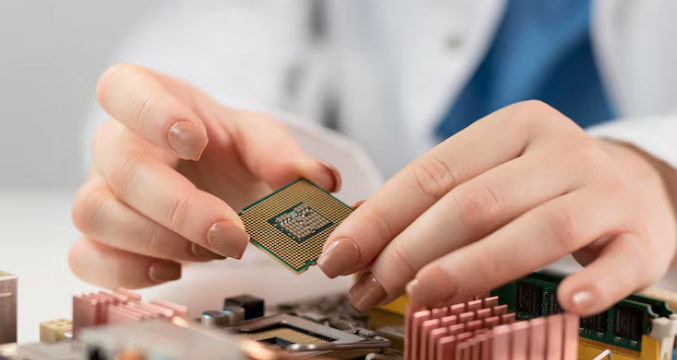
The uneven distribution of growth is crucial to comprehending the true significance of the trillion-dollar milestone for various segments of the industry. The growth of high-bandwidth memory, the kind of chip necessary to run big AI models at the speed needed by data center operators, is changing how capital is allocated throughout the memory market. In an effort to chase the high-end margins, major suppliers have been purposefully choosing to prioritize HBM production over traditional NAND flash capacity.
Ironically, this has led to a growing shortage of NAND flash, the technology that powers the solid-state drives found in everything from laptops to large servers. The same capital and manufacturing capacity that are being drawn toward the production of cutting-edge AI chips are also being drawn away from commodity memory, creating tightness in a segment that the overall growth story tends to obscure. This is the kind of secondary effect that gets lost in headline discussions of a trillion-dollar boom.
Everything revolves around the GPU market. The company’s data center revenue has increased at a rate that would have seemed unthinkable as recently as 2022, and the waiting lists for its most cutting-edge products have occasionally lasted well over a year. Nvidia’s dominance in AI training chips is so well documented that it hardly needs further explanation. The extent to which Nvidia’s success has altered investment and competitive strategy throughout the semiconductor industry is perhaps more intriguing—and less talked about. AMD has been actively promoting AI accelerators. Intel is attempting to become relevant again in the field of advanced manufacturing. Google, Amazon, Microsoft, and Meta have all increased their custom silicon efforts in an effort to become less reliant on outside vendors for the chips that power their AI workloads. This multiplying investment is partly responsible for the trillion-dollar market, which is a widespread industrial mobilization rather than the success of a single company.
The current growth rate might be sustainable for the duration of the decade. According to the majority of reliable assessments, the development of AI infrastructure, including data centers, networking equipment, and the chips that power both, is still in its early stages. As AI applications progress from development to widespread deployment, it is anticipated that the inference side of AI, which necessitates different chip configurations than training, will become its own significant demand category. Although they have taken longer to materialize than anticipated, automotive applications continue to be a long-term demand driver. The question is not so much whether demand will continue to rise.
The question is whether the supply chain can expand along with it, building enough factories, training enough engineers, and sourcing enough materials without the bottlenecks and price shocks that typified the chip shortage from 2020 to 2022. Observing the growing number of capacity investment announcements from TSMC, Samsung, Intel, and other government-backed chip initiatives in the US and Europe gives the impression that the industry is aware of this risk and is taking appropriate action. The more difficult question, which the trillion-dollar milestone, despite its importance, does not address, is whether the response will be quick enough and well-calibrated enough to match demand without creating the next oversupply cycle.
