

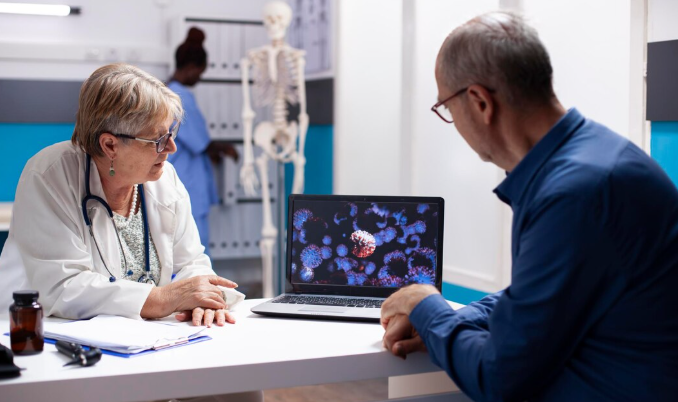
There used to be a familiar rhythm in the exam room. A patient spoke. After nodding and asking some questions, the doctor eventually turned to face a computer screen. Tapping fingers. The patient’s eyes stray to the keyboard. The majority of people hardly noticed the scene anymore because it had become so commonplace.
In certain clinics, a subtle change is currently taking place. The physician is looking up once more.
| Category | Details |
|---|---|
| Technology | AI Clinical Scribes / Ambient AI Documentation |
| Core Function | Automatically transcribes and summarizes doctor–patient conversations into medical notes |
| Technologies Used | Speech recognition, natural language processing, large language models |
| Primary Goal | Reduce physician documentation workload and improve patient interaction |
| Key Benefits | Faster note creation, reduced burnout, more eye contact with patients |
| Main Concerns | Privacy, medical errors, algorithmic bias, over-reliance on AI |
| Early Adoption Areas | Primary care, psychiatry, telemedicine |
| Estimated Error Rate | Some studies report around three documentation errors per note |
| Stakeholders | Doctors, patients, hospitals, health IT companies |
| Reference Source | https://pmc.ncbi.nlm.nih.gov/articles/PMC11701814/ |
Even though it may seem insignificant, this change frequently has its roots in the AI scribe, a silent technological assistant. During consultations, these systems listen in on conversations and automatically generate structured medical notes. Algorithms perform the transcription and summarization during visits in place of physicians typing. Although it’s a routine task, the consequences affect the doctor-patient relationship as a whole.
Physicians frequently describe the experience with surprising enthusiasm, according to researchers studying AI scribes. Because the tools eliminate hours of documentation after clinic hours, some have even referred to them as “life-changing.” Users reported increased productivity and note quality, as well as more organic interactions with patients, in focus groups with medical professionals. However, hesitation is accompanied by enthusiasm. Anything that functions too well is rarely trusted in medicine.
Anyone who has worked in a contemporary hospital knows how much paperwork there is. Despite being introduced with the promise of efficiency, electronic health records frequently had the opposite effect. Physicians started working as data clerks. One doctor once made the joke that while medical school taught him how to treat patients, it did not teach him how to type at 90 words per minute.
Imagine a normal primary care visit. The doctor asks the patient about their symptoms while they sit on an examination table covered with paper. An AI model listens and transforms speech into structured notes, such as the history of the current illness, medications, assessment, and plan, either in the room or occasionally embedded in software that runs silently on the computer. The paperwork is completed by the time the patient departs.
The immediate outcome is useful. Physicians spend more time talking to patients face-to-face and less time typing. Higher engagement during consultations is reported in a number of early trials, where doctors ask follow-up questions more naturally and maintain eye contact for longer.
It’s difficult to ignore something a little ironic as you watch this change take place. In fact, a machine designed to automate paperwork might bring back a more human approach to medicine. However, there are usually conditions attached to optimism in healthcare technology.
Research assessing commercial AI scribes has discovered mistakes, sometimes minor, sometimes concerning. According to one analysis, each clinical note contained an average of about three errors, which frequently involved missing information or misconstrued phrases. The majority can be fixed, but the presence of mistakes makes it difficult to decide how much authority doctors should give to software that might occasionally misinterpret a diagnosis. Physicians themselves appear to be split.
AI scribes are viewed by some as a long-overdue solution to administrative burden, particularly in professions like psychiatry where thorough notes are crucial. Some are concerned about becoming overly dependent on automated summaries or losing control over documentation. Additionally, there is the sensitive matter of privacy. These systems, after all, capture extremely private medical discussions.
Meanwhile, patients seem hesitantly receptive to the concept. According to surveys, a lot of people see AI as a helpful tool rather than a substitute for human care. For them, trust and attention are the most important things. Patients frequently embrace technology that enables physicians to listen more intently. Exam room social dynamics are still complex, though.
After all, an algorithm cannot accurately capture empathy. When describing anxiety, grief, or chronic pain, a patient frequently uses tone and pauses rather than exact words. The emotional content of the interaction is still a human responsibility, even though AI systems may record the transcript.
Additionally, there is the larger cultural change taking place within the medical field. From diagnostic imaging to treatment recommendations and predictive analytics, algorithms have progressively advanced over the last ten years. AI scribes are a more subdued type of integration that focuses more on workflow than clinical judgments.
Workflows, however, influence behavior. Conversations shift when doctors stop typing. Consultations become more conversational and somewhat less transactional. Even though appointment times don’t change, some clinicians say they feel less hurried. Although it’s a subtle psychological effect, it suggests a more profound transformation.
However, it’s still unclear if AI scribes will result in the productivity increases that hospitals anticipate. In professional settings, technology frequently promises efficiency that doesn’t materialize right away. When it comes to patient safety, healthcare systems are cautious—sometimes painfully so.
There’s a feeling that something significant might be happening when you stand outside a busy clinic late in the afternoon and watch doctors finally leave before sunset rather than staying to complete charts. One of the key problems in contemporary medicine is burnout, and documentation is crucial.
The impact might go beyond efficiency if algorithms are able to take on that load, even in part. It might alter the tone of medicine itself.
The deeper question is still unanswered, of course. Is the AI scribe just a digital secretary, or is it the beginning of a more autonomous clinical care system?
The majority of doctors currently appear to be at ease with the current setup. The AI pays attention. The physician makes the decision.
And for the time being, both patients and physicians seem to want that balance.
